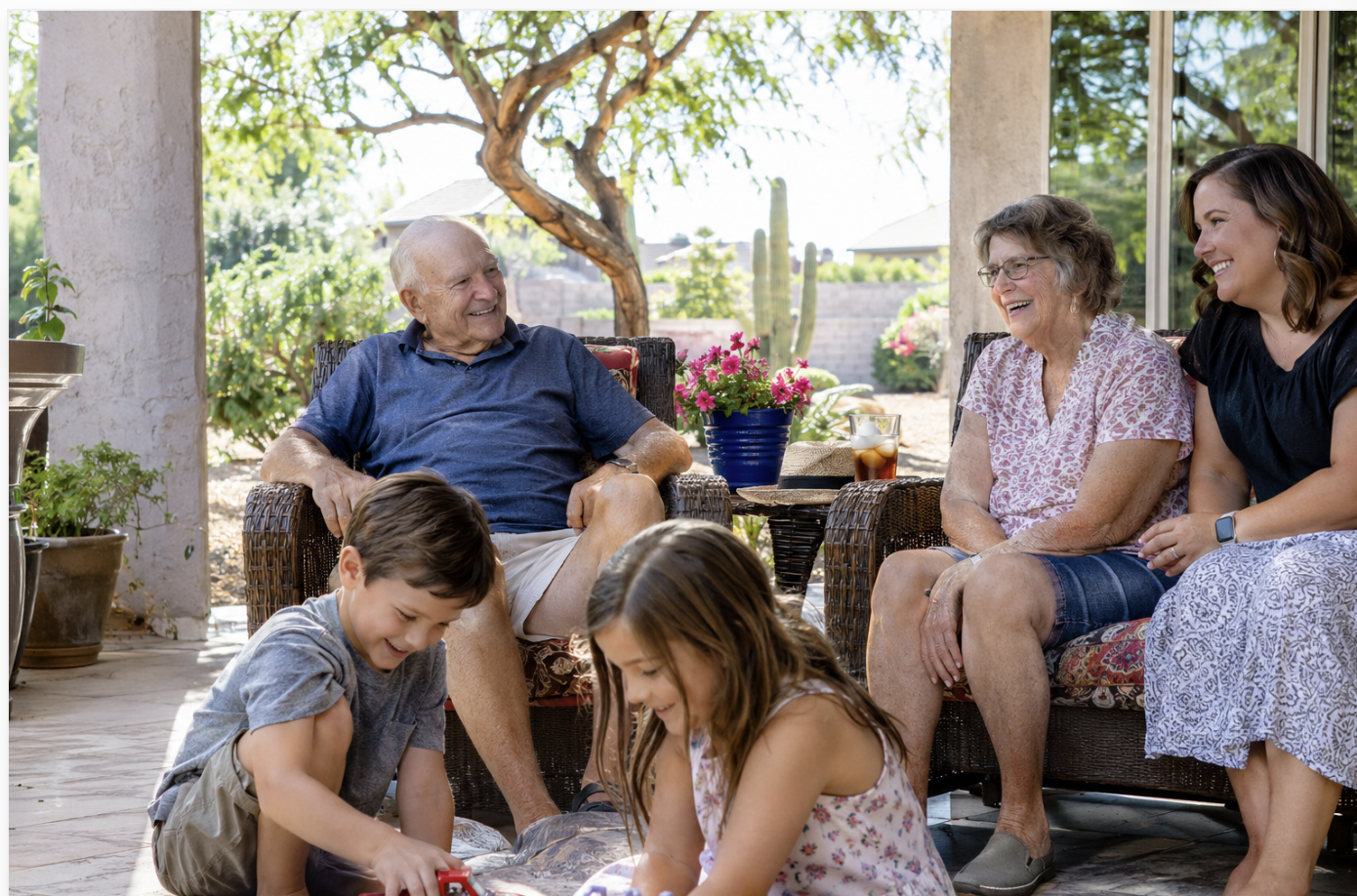
We Were Your Neighbors Before We Were Your Hospice
There is a moment many families experience but rarely talk about.
It is the moment you realize the person who has always taken care of everyone else might now need someone to take care of them.
Maybe it happens when your father stops working in the garage. When your mother begins forgetting to eat. Or when the spouse who has spent 50 years caring for the person they love quietly admits, "I don't know how much longer I can do this."
And suddenly, the family that has always figured things out together doesn't know what to do next.
At Mountain View Hospice, we believe families deserve to have someone in their corner long before they reach that moment.
Because being someone's hometown hospice means being their neighbor first.
The Man Who Always Had the Answers
The following story is fictional, but it reflects experiences familiar to many families navigating serious illness.
For most of her life, Sarah's dad had been the person everyone called when something went wrong.
A broken washing machine? Call Dad.
Need help moving furniture? Dad would be there with his truck.
A Little League team needed a coach? He volunteered before anyone else raised a hand.
He knew his neighbors in Surprise, Arizona, by name. He could tell you which family had just welcomed a baby and whose grandchildren were visiting for the weekend.
He was the kind of man who showed up.
But lately, he wasn't showing up the way he used to.
The garage stayed closed. His tools collected dust. Sunday dinners became shorter because he was too tired to sit at the table.
Walking from the bedroom to the kitchen left him breathless.
Sarah's mother insisted everything was fine.
"Your dad's just getting older," she would say.
But Sarah noticed the unopened mail, the medication bottles scattered across the counter, and the way her mother seemed to be awake every time she called.
One Sunday, Sarah finally said what everyone had been avoiding.
"Mom, do you think we should ask about hospice?"
Her mother's expression changed immediately.
"Absolutely not. Your father isn't dying. We're not ready for that."
And just like that, the conversation ended.
Sarah went home feeling guilty.
Had she given up on her father?
Was she suggesting something terrible?
Or was she simply recognizing that her parents needed more help than anyone wanted to admit?
Sometimes the First Step Isn't Hospice. It's Having Someone Listen.
A few days later, Sarah attended a caregiver gathering in the West Valley.
She wasn't looking for a hospice company.
She was looking for answers.
While talking with another attendee, she was introduced to someone involved with Mountain View Hospice.
There was no sales pitch.
No stack of paperwork.
No pressure to make a decision.
Instead, someone asked her a question she hadn't heard in months.
"How are you doing?"
Sarah immediately began crying.
Not because anyone had said something profound.
But because someone had finally asked.
She talked about her father's declining health, her mother's exhaustion, and the guilt she felt even mentioning hospice.
And someone listened.
Then they helped her understand something important.
Hospice isn't necessarily about the last few days of someone's life.
It can be about helping someone live more comfortably while supporting the people who love them.
Sarah learned that asking for a hospice evaluation didn't mean committing to hospice care. It simply meant learning whether her father might qualify and what support could be available.
For the first time in months, she felt like her family had options.
What Does It Really Mean to Be a Hometown Hospice?
When we founded Mountain View Hospice in 2018, we wanted to build something that felt different.
Not because we believed other healthcare organizations weren't doing meaningful work.
But because we knew firsthand how much relationships matter when someone is facing serious illness.
We are locally owned and operated by registered nurses.
We understand what happens at the bedside because we've been there.
We've watched families struggle with difficult decisions. We've sat with frightened spouses, answered questions at inconvenient hours, and witnessed the relief that comes when someone finally understands what is happening to their loved one.
But we also believe our responsibility to the community extends far beyond the patients on our census.
We live here.
We raise our families here.
We shop at the same grocery stores, attend local events, volunteer, and build relationships with the people who make the West Valley home.
And we believe that being part of a community means showing up even when there is absolutely nothing to gain.
We don't want the first time someone hears about Mountain View Hospice to be the day their family is facing a crisis.
We want them to know us as neighbors, educators, advocates, and people who care.
Our Community Involvement Isn't a Marketing Strategy. It's Who We Are.
Walk into a Memory Café in Buckeye, Festival, or Surprise, and you might see something beautiful.
A husband living with dementia laughing as he participates in an activity.
A wife who has spent months feeling isolated finally talking with someone who understands what her days look like.
A daughter watching her mother smile in a way she hasn't seen in weeks.
There are conversations, activities, laughter, and sometimes tears.
Nobody is there to be a perfect caregiver.
Nobody needs to explain why their loved one repeats the same question or struggles to remember someone's name.
They simply get to belong.
Through our involvement with Dementia Friendly Buckeye and Surprise, Memory Cafés, caregiver support groups, and dementia education initiatives, we have the privilege of helping create these moments.
We work alongside volunteers, senior centers, nonprofit organizations, healthcare professionals, and community advocates who believe that people living with dementia and their caregivers deserve meaningful connections.
At the Buckeye Senior Center, for example, a Memory Café is more than an activity on the calendar.
It can be the one morning each month when a caregiver doesn't feel alone.
It can be the place where someone learns about transportation resources, meets another family facing similar challenges, or simply enjoys a conversation without worrying about being judged.
We also participate in community education and symposiums where families can learn practical ways to navigate dementia, caregiving, and the challenges of aging.
And here's something important.
Many of the people we meet through these programs will never become Mountain View Hospice patients.
That's perfectly fine.
We aren't there because someone might need hospice.
We're there because someone needs support today.
Whether that means answering a question, connecting a caregiver with a resource, or helping another organization reach the people who need its services, we believe that is time well spent.
Sometimes the most valuable thing we can do is introduce a family to someone else who can help them.
That's not a missed opportunity.
That's community.
Why Are We So Afraid of the Word Hospice?
Over the years, we've heard families say many of the same things Sarah's mother said.
"We're not ready."
"He's still eating."
"She's still getting out of bed."
"The doctor hasn't told us it's time."
"We don't want to give up hope."
These feelings are understandable.
For many people, hospice has become associated with the very last moments of life.
But that isn't the whole picture.
Under Medicare's hospice benefit, hospice care is generally available when the appropriate physicians certify that someone has a life expectancy of six months or less if their illness follows its expected course, along with other eligibility requirements.
That does not mean someone must be actively dying.
And it certainly doesn't mean anyone knows exactly how much time that person has left.
Hospice shifts the focus of care toward comfort, dignity, quality of life, and support.
Depending on the patient's needs and plan of care, hospice can provide nursing visits, symptom management, personal care assistance, social work, spiritual support, medical equipment, and medications related to the terminal illness.
It also provides something families desperately need.
Education.
Someone to explain what changes might mean.
Someone to help them prepare.
Someone to call when something doesn't seem right.
Hospice doesn't eliminate every difficult moment, but it can help families feel less alone as they navigate them.
And families can request information or an evaluation without committing to enrollment.
What Happens When Families Receive Help Earlier?
Remember Sarah and her parents?
After talking things through, Sarah arranged for her father to receive a hospice evaluation.
He met the eligibility requirements, and after discussing his wishes and options, he chose to begin hospice care.
The first few weeks brought changes.
A nurse helped the family understand his medications and symptoms.
His wife learned what to watch for and whom to call with concerns.
Sarah no longer felt responsible for figuring out every detail on her own.
There were still difficult days.
Her father still had a serious illness.
But something had shifted.
One afternoon, Sarah stopped by her parents' house and found her father sitting in his favorite chair near the window.
The grandchildren were playing on the floor.
Her mother was laughing at something one of them had said.
Nobody was discussing medication schedules.
Nobody was searching the internet for answers.
Nobody was arguing about what should happen next.
For a little while, they were simply a family again.
And sometimes, that is one of the greatest gifts supportive care can offer.
Why Local Relationships Matter in Hospice Care
When someone you love becomes seriously ill, healthcare stops being an abstract system.
It becomes personal.
You want to know who is coming into your home.
You want your questions answered.
You want to trust that the people caring for your mother, father, spouse, or grandparent understand what matters to your family.
At Mountain View Hospice, our registered nurses provide field nursing care, supported by an interdisciplinary team.
We work to maintain manageable caseloads because we believe patients deserve personalized attention.
Our hospice support is available 24 hours a day, seven days a week.
And because we are rooted in the West Valley, we understand the communities and resources available to families in Surprise, Buckeye, Goodyear, Peoria, Sun City, and Sun City West.
We know that sometimes a family needs hospice care.
Sometimes they need a caregiver support group.
Sometimes they need help understanding dementia, finding community services, or simply knowing which questions to ask.
We want to be a resource for all of those conversations.
Not because every conversation leads to a patient.
But because every conversation involves a person.
We Were Part of Their Community Before We Became Part of Their Care
Several months later, Sarah attended another community gathering.
Across the room, she recognized the person who had listened to her when she first began asking questions about her father's health.
She walked over to say hello.
"How's your dad doing?" the person asked.
Sarah smiled.
"He's still making jokes. Mom is sleeping better. And we're finally spending time together instead of worrying every minute."
Then she added something that stayed with the person listening.
"I didn't know what we needed that day. I just knew we couldn't keep doing it alone."
Sarah's family hadn't found Mountain View Hospice because of an advertisement.
They found us because we were already part of their community.
And when they needed help, there was already a relationship built on trust.
A Good Neighbor First. A Hospice Provider When You Need One.
One day, the person sitting beside us at a Memory Café may need hospice.
The exhausted caregiver we meet at a support group may need guidance for a parent whose health is declining.
The neighbor who asks a simple question about dementia may someday face decisions they never imagined making.
And if that day comes, we hope they remember something more important than our name.
We hope they remember that someone listened.
That someone cared enough to answer their questions.
That someone helped them find resources without expecting anything in return.
That someone showed up.
Long before hospice was ever part of the conversation.
Because we don't believe you have to become our patient to matter to us.
We were your neighbors before we were your hospice. And we'll continue being your neighbors whether you ever need hospice or not.
Mountain View Hospice. Your Hometown Hospice of Choice.
If you're caring for someone you love and don't know where to turn, reach out to Mountain View Hospice at 623-230-3698. Whether you have questions about hospice, dementia, caregiver support, or community resources, we're happy to help you explore your options.
You don't have to know exactly what you need before starting a conversation.
Sometimes you just need someone who knows where to begin.