When the Holidays Feel Different: Navigating a Loved One’s Declining Health
Top Hospice in Sun City West, Az
The holidays are supposed to feel joyful.
The lights go up. The familiar recipes come out. Families make plans. Grandchildren run through the house. Someone complains that the tree is crooked, someone else sneaks a cookie before dinner, and for a few precious hours, life is supposed to feel normal.
But sometimes it doesn’t.
Sometimes the person who has always been at the center of the holiday is sitting quietly in a chair, too tired to participate.
Sometimes Mom doesn’t remember the recipe she made every Christmas for forty years.
Sometimes Dad needs help getting from the bedroom to the living room.
Sometimes the family spends more time talking about medications, appointments, falls, oxygen, weight loss, confusion, or another trip to the emergency room than they do talking about Christmas dinner.
And suddenly, the holidays become a painful reminder that life is changing.
The Christmas That Felt Different
Imagine a daughter named Sarah.
Every Christmas morning, Sarah’s father was the first person awake.
He made coffee before anyone else came downstairs. He turned on Christmas music far too early. He insisted on passing out every present himself, even when the grandchildren were practically climbing over one another trying to get to the tree.
That was Dad.
But this year was different.
When Sarah arrived at her parents’ house a few days before Christmas, the tree was up, but half the ornaments were still sitting in boxes.
Her father was sleeping in his recliner.
Her mother quietly pulled Sarah into the kitchen.
“He just isn’t bouncing back anymore,” she whispered.
There had been three hospitalizations that year.
A fall.
A bout of pneumonia.
Weeks of therapy.
Less appetite.
More sleeping.
More confusion.
And every time he came home, the family told themselves the same thing:
“He just needs a little more time to get stronger.”
But this time, Sarah could see what her mother had been afraid to say.
He wasn’t getting stronger.
At dinner that night, Dad ate only half and pushed his plate away.
Later, Sarah helped him walk down the hallway.
The man who once carried his grandchildren on his shoulders was now leaning heavily on his daughter just to get to bed.
When she tucked the blanket around him, he looked up and said quietly,
“I’m sorry this Christmas isn’t very much fun.”
Sarah went into the bathroom and cried.
Not because Christmas was ruined.
Because she suddenly understood that her family was entering a chapter none of them knew how to navigate.
Families Often Know Something Is Changing Before They Know What to Call It
Declining health rarely announces itself clearly.
It often happens little by little.
Your loved one may start sleeping more.
Eating less.
Losing weight.
Becoming weaker.
Falling more frequently.
Needing more help bathing, dressing, walking, or using the bathroom.
Hospitalizations may become more frequent.
Recovery may take longer.
Chronic conditions such as heart failure, COPD, dementia, cancer, kidney disease, Parkinson’s disease, or other serious illnesses may begin taking more from the person than they once did.
Families frequently respond by working harder.
They schedule more appointments.
Pick up more prescriptions.
Add another specialist.
Take another trip to the emergency room.
Stay up another night.
Miss another day of work.
And during the holidays, families often push themselves even harder because everyone desperately wants things to feel the way they used to.
But sometimes the most important question is no longer:
“How do we get everything back to normal?”
Sometimes the question becomes:
“What does my loved one need now?”
Hospice Can Be Part of the Health Journey Before the Final Days
One of the greatest misconceptions about hospice is that families should wait until someone is actively dying.
That belief causes many families to miss months of support they could have received.
Hospice is not simply about the final hours of life.
Hospice can become an important part of the health journey when someone is living with a serious illness, experiencing continued decline, and when the focus of care begins shifting toward comfort, symptom management, quality of life, and support.
Hospice does not mean the family stops caring.
It often means the family finally gets help carrying the weight.
Instead of one exhausted spouse trying to manage everything alone, there is a team.
Instead of wondering whom to call at night when something changes, families have clinical support.
Instead of feeling like every worsening symptom automatically requires another trip to the hospital, there may be another option.
Instead of spending the holidays only managing illness, families can sometimes begin spending more time simply being together.
Hospice Gives Families Something They Are Often Running Out Of: Support
When someone you love is declining, caregiving can quietly take over the entire relationship.
A wife becomes a medication manager.
A husband becomes a full-time caregiver.
A daughter becomes the person coordinating appointments.
A son becomes the one answering phone calls from doctors and facilities.
Everyone begins doing tasks.
And somewhere along the way, it becomes difficult to simply be a husband, wife, daughter, son, grandchild, or friend.
Hospice can help with symptom management, nursing care, personal care, emotional and spiritual support, medical equipment related to the terminal diagnosis, medications associated with comfort and the hospice plan of care, caregiver education, and guidance when changes occur.
But there is another benefit that is harder to measure.
Hospice can give families permission to stop doing everything alone.
That matters.
Especially during the holidays.
Maybe Christmas Does Not Have to Look the Same
After Sarah’s family learned more about hospice, they decided to request an evaluation.
They were surprised by the conversation.
No one told them they had to stop loving him.
No one told them to stop celebrating Christmas.
No one told them the end was happening tomorrow.
Instead, the conversation focused on what mattered to her father.
What made him comfortable?
What symptoms were bothering him?
What did he want to avoid?
What was most important to the family?
The answers were simple.
He wanted to be home.
He wanted to stay out of the hospital if possible.
He wanted to sit in his recliner.
He wanted his wife nearby.
And he wanted Christmas with his family.
So that year, they changed Christmas.
Dinner was earlier because Dad tired easily.
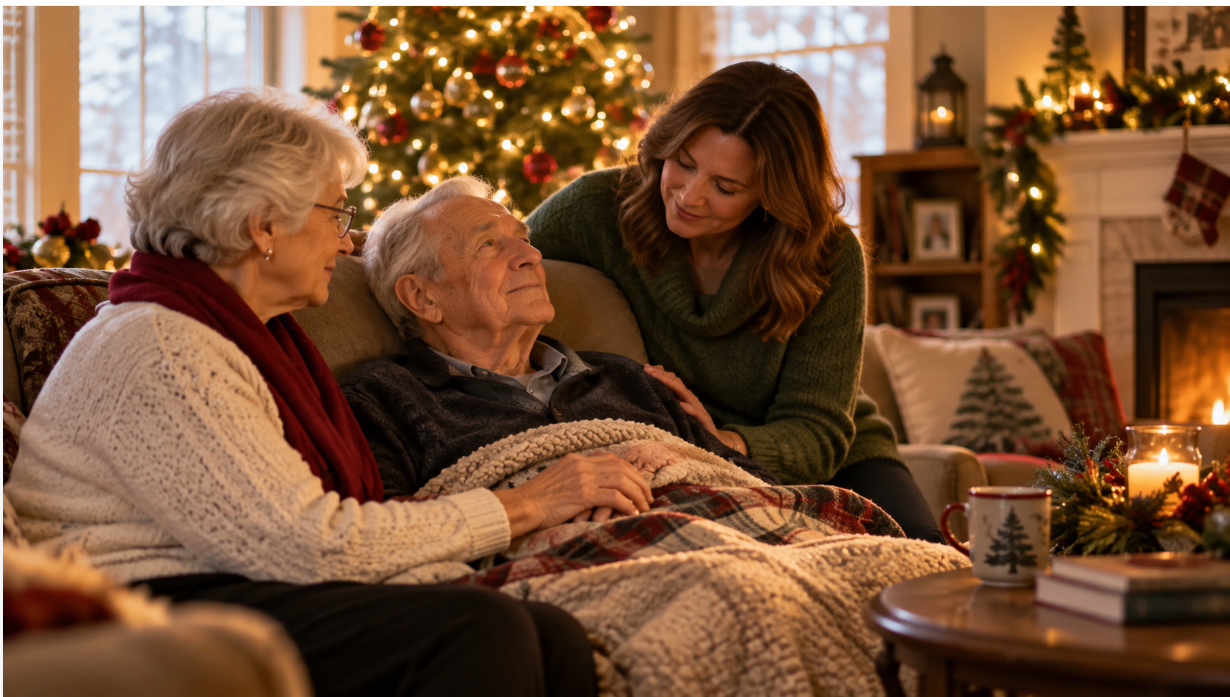
The grandchildren opened presents beside his recliner instead of around the tree.
His favorite Christmas music played quietly in the background.
Nobody worried about making everything perfect.
And when his youngest granddaughter climbed into his lap and showed him the toy Santa brought her, he smiled.
For a few minutes, nobody was thinking about medications.
Nobody was talking about appointments.
Nobody was planning the next hospitalization.
They were simply together.
And Sarah realized something.
This Christmas was different.
But different did not mean meaningless.
There Is Grief Even Before Someone Dies
One of the hardest parts of watching someone decline is experiencing what is sometimes called anticipatory grief.
You may grieve the person they used to be.
The traditions they can no longer participate in.
The conversations that have changed.
The independence they have lost.
The future you assumed you still had together.
You may feel sadness and gratitude at the same time.
You may laugh one moment and cry the next.
You may feel guilty for wishing things were easier.
You may feel exhausted.
You may even feel relief when someone finally offers help.
All of those emotions can coexist.
The holidays often magnify them.
That is why support matters.
Sometimes the Greatest Gift Is Not More Treatment. It Is More Meaningful Time.
There comes a point in many serious illnesses when families begin asking different questions.
Not just:
“What else can we do medically?”
But:
“How do we make the time we have meaningful?”
“How do we keep Mom comfortable?”
“How do we keep Dad from going back and forth to the hospital?”
“How do we know when things are changing?”
“How do we care for them without completely exhausting ourselves?”
“What would they want this season to look like?”
Those are not questions of giving up.
They are questions of love.
You Do Not Have to Wait for a Crisis to Ask About Hospice
If you are watching someone you love decline this holiday season, you do not have to know whether hospice is the right answer before asking questions.
That is what an evaluation is for.
A conversation can help you understand whether your loved one may qualify for hospice, whether another type of care may be more appropriate, and what support is available.
Sometimes the answer is, “Not yet.”
Sometimes the answer is, “Yes, we can help.”
Either way, families deserve information before they are standing in an emergency room at 2:00 in the morning trying to make major decisions during a crisis.
At Mountain View Hospice, we believe families should understand their options early enough to actually benefit from them.
Because hospice should not only be about how someone dies.
It should also be about how they live while they are still here.
And during a season filled with traditions, memories, faith, family, and love, sometimes the most meaningful gift we can give someone is comfort, dignity, presence, and the opportunity to simply be together.
This holiday season may look different.
The table may have changed.
The traditions may need to change.
Your loved one may have changed.
But there can still be laughter.
There can still be music.
There can still be stories.
There can still be prayer.
There can still be a hand to hold.
And there can still be beautiful moments worth remembering.
Sometimes we just need a little help making room for them.