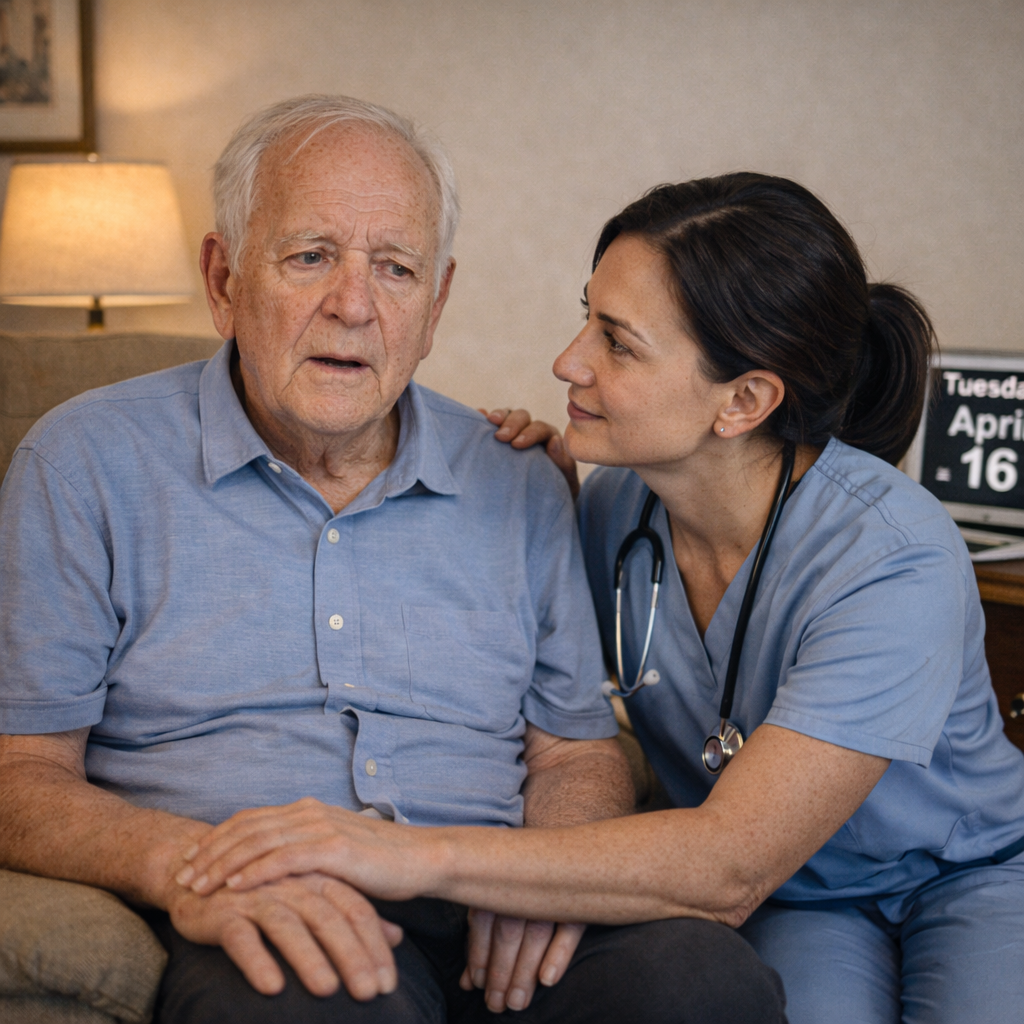
Understanding the FAST Scale in Dementia
What Stage Is My Loved One In — And When Is It Time for Hospice?
If you are searching for:
“FAST scale dementia”
“What stage is my loved one in?”
“When does dementia qualify for hospice?”
“How fast does dementia progress?”
You are likely noticing changes.
The FAST Scale (Functional Assessment Staging Tool) is one of the primary tools used by medical professionals to measure the progression of Alzheimer’s disease and other dementias.
It focuses on functional decline — what a person can and cannot do independently.
And it plays a major role in determining hospice eligibility.
What Is the FAST Scale?
The FAST Scale was developed by Dr. Barry Reisberg to track the stages of Alzheimer’s disease.
Unlike general “early, middle, late” descriptions, the FAST Scale breaks dementia into 7 stages, with sub-stages in the later phase.
It is widely used by physicians and hospice providers to determine when someone may qualify for end-of-life support.
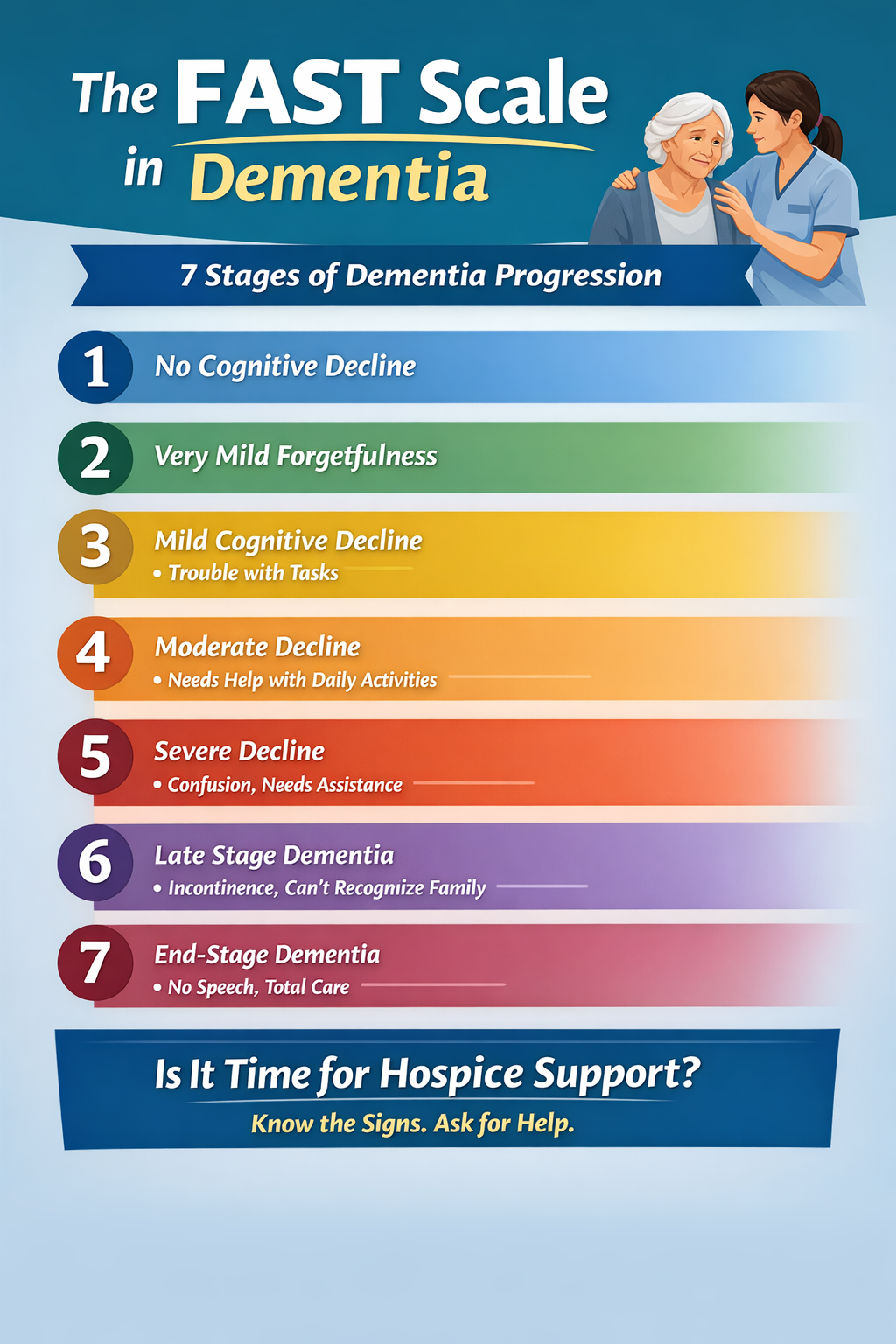
The 7 Stages of the FAST Scale
Stage 7: Very Severe Cognitive Decline (End-Stage Dementia)This is the stage most closely associated with hospice eligibility.
Signs include:
Limited or no meaningful speech (often 6 words or fewer)
Inability to walk independently
Inability to sit up without assistance
Difficulty smiling
Trouble holding head up
Difficulty swallowing
Recurrent infections
Significant weight loss
At this point, dementia is considered terminal.
Stage 6: Severe Cognitive Decline (Late Stage Dementia)This stage is broken into subcategories:
Needs assistance dressing
Needs help bathing
Urinary or fecal incontinence
Difficulty recognizing family members
Personality changes may intensify.
Communication becomes very limited.
Families often feel they are “losing” their loved one while they are still physically present.
Stage 5: Moderately Severe Cognitive Decline (Middle Stage)More supervision is needed.
Needs help choosing proper clothing
Forgets important personal details (address, phone number)
Increasing confusion
Safety becomes a concern.
Stage 3: Mild Cognitive DeclineStage 4: Moderate Cognitive Decline (Early Dementia)Clear diagnosis is often made here.
Difficulty managing finances
Trouble planning meals
Withdrawal from social settings
Independence begins to decline.
Stage 3; Mild Cognitive Decline
Early signs of dementia may appear.
Trouble with work tasks
Word-finding difficulty
Getting lost in familiar places
Family members often begin noticing changes.
Stage 2: Very Mild Cognitive DeclineNormal aging-related forgetfulness.
Misplacing items
Occasionally forgetting names
Often not diagnosed at this stage.
Stage 1: No Cognitive Decline
No noticeable memory problems.
When Does Dementia Qualify for Hospice?
Hospice eligibility for dementia typically begins at:
FAST Stage 7C or beyond
Combined with complications such as:
Recurrent pneumonia
Aspiration
Significant weight loss
Pressure wounds
Frequent hospitalizations
Decline in overall health
Many families wait too long.
They are exhausted.
They are overwhelmed.
They are unsure if it is “time.”
If your loved one is no longer walking, talking meaningfully, or eating well — it is appropriate to request a hospice evaluation.
And there is no cost to ask.
Why the FAST Scale Matters to Families
The FAST Scale gives structure to something that feels chaotic.
It answers:
“Is this normal?”
“Are we in late stage?”
“How much time do we have?”
“Should we be doing more?”
It provides clarity when emotions are high and decisions feel heavy.
Signs It May Be Time to Call Hospice for Dementia
You may notice:
Sleeping most of the day
Eating very little
Increased falls
Infections becoming more frequent
Weight loss
Increased confusion
Difficulty swallowing
If you are asking the question, it is time for a conversation.
Not necessarily enrollment.
Just a conversation.
What Hospice Does for Late-Stage Dementia
Hospice does not “speed anything up.”
Hospice provides:
Skilled nursing oversight
CNA support for bathing and hygiene
Comfort-focused medication management
Emotional support for family
Guidance on what to expect next
Prevention of unnecessary hospitalizations
Most importantly:
We support both the patient AND the caregiver.
Frequently Asked Questions About the FAST Scale and Hospice
Is the FAST scale only for Alzheimer’s?
It was developed for Alzheimer’s but is widely used for other progressive dementias.
Does Stage 7 mean death is immediate?
No. Stage 7 indicates advanced decline. The timeline varies for each person.
Can someone improve once they reach Stage 7?
Dementia is progressive and not reversible. Focus shifts to comfort and quality of life.
Who determines hospice eligibility?
A physician and hospice medical director review clinical criteria.
You Don’t Have to Figure This Out Alone
If you believe your loved one may be in late-stage dementia, you do not have to guess.
You can request a no-cost hospice evaluation.
You can ask questions.
You can talk through what you are seeing.
Mountain View Hospice is nurse-owned, locally operated, and serves families throughout the West Valley.
📞 Call 623-230-3698
Even if you just need clarity.