We Thought Hospice Meant Giving Up. Instead, It Gave Us Our Family Back.
Scottsdale, Az
The family in this story is based on one of our families with permission. Their emotions, questions, and experiences reflect what many families face when considering hospice care.
There was a time when almost every phone call I made to my parents started the same way.
“Dad, how is Mom today?”
And every time, he gave me nearly the same answer.
“We’re doing okay.”
I lived several hundred miles away, so I learned to listen to everything he wasn’t saying.
I listened to the pauses.
I listened to how tired his voice sounded.
I noticed when “Mom had a good day” started meaning she had eaten half a sandwich.
I noticed when he casually mentioned that she had almost fallen getting out of the bathroom.
I noticed when he told me she was sleeping more.
I noticed when he said she didn’t really feel like talking.
And I noticed that every time I suggested he might need more help, he changed the subject.
My parents had been married for more than 45 years.
My dad had always been the one who fixed things.
The leaking faucet.
The car that wouldn’t start.
The broken cabinet door.
And now, somehow, he believed he should be able to fix this too.
Only this wasn’t a faucet.
This was my mom.
And she was getting weaker.
“I Promised Her I Would Take Care of Her”
If you asked my dad during those months whether he was a caregiver, I don’t think he would have called himself one.
He was her husband.
That was how he saw it.
He made her breakfast.
He organized her medications.
He helped her shower.
He walked behind her when she moved through the house because he was afraid she might fall.
He kept track of doctor appointments.
He washed the sheets when she had an accident.
He stayed awake when she had a bad night.
He drove her to the emergency room when he wasn’t sure whether something was serious.
Then he brought her home and started all over again.
But if you asked him how he was doing?
“We’re doing okay.”
Years later, when we talked about that season, Dad admitted something to me.
“I thought asking for help meant I wasn’t doing my job.”
That one sentence explained so much.
He had promised my mother years before that he would take care of her.
To him, hospice sounded like handing that responsibility over to strangers.
And he wasn’t ready to do that.
The Word Nobody Wanted to Say
I don’t remember exactly who first mentioned hospice.
Maybe it was one of Mom’s doctors.
Maybe it was a nurse during another hospital visit.
I just remember Dad’s reaction.
“Hospice?”
There was a long silence.
Then he said:
“She’s not dying today.”
I knew exactly what he meant.
Because somewhere in my mind, I thought hospice meant the same thing.
I pictured someone lying in a hospital bed, unconscious, with family gathered around saying goodbye.
That wasn’t my mom.
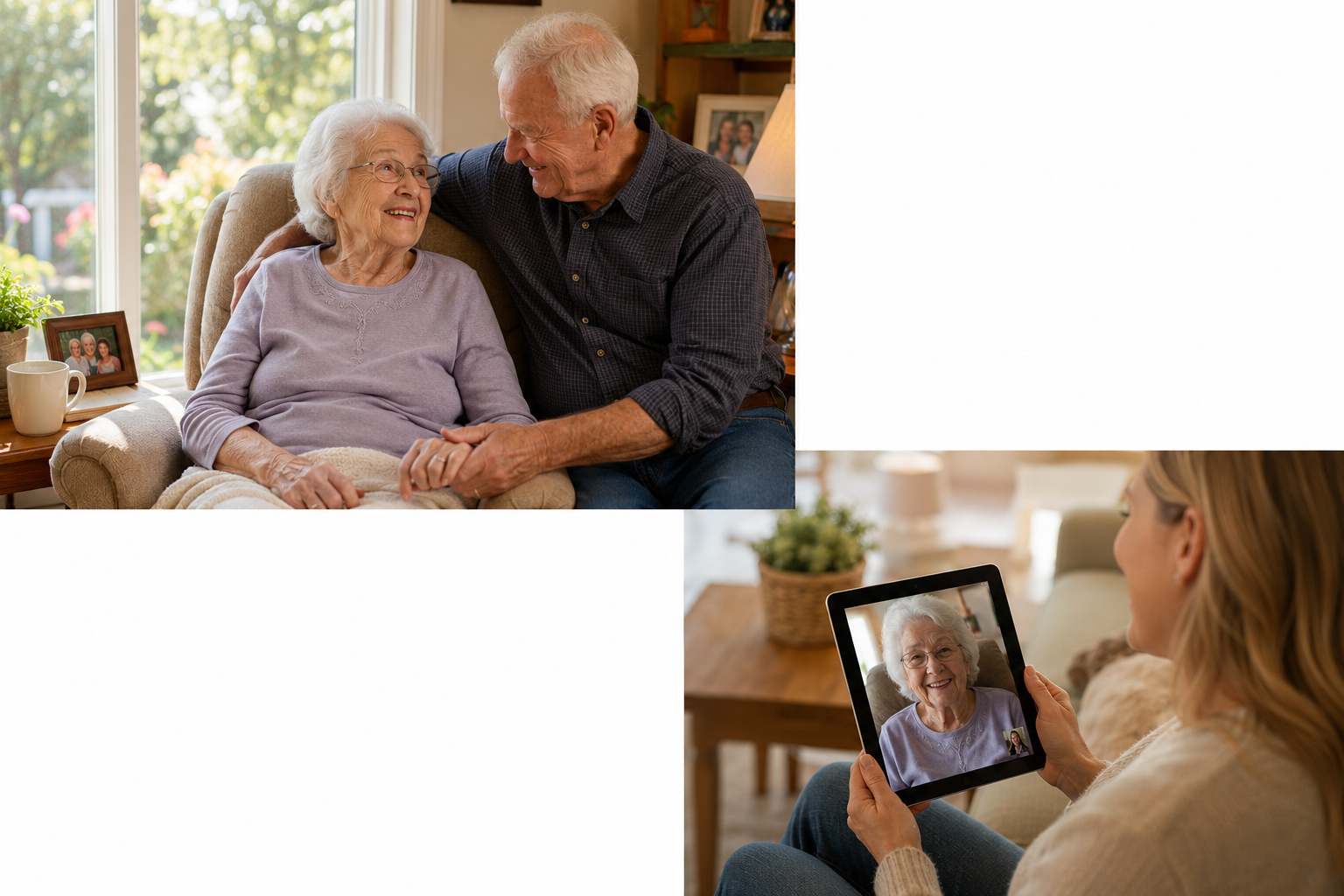
My mom still sat in her favorite chair near the living room window.
She still complained if Dad made her coffee too weak.
She still watched the birds outside.
She still laughed when one of the grandchildren did something ridiculous on FaceTime.
She still corrected my father when he told a story wrong.
How could that possibly be hospice?
So I didn’t argue with him.
But that night, sitting alone at my kitchen table in another state, I opened my phone and started searching.
Is it too early for hospice?
Then:
Can someone still talk and walk on hospice?
Then:
Does hospice mean someone is dying right away?
Then:
Can hospice help someone stay at home?
I probably read for two hours.
And slowly, I started realizing something.
Maybe hospice wasn’t what we thought it was.
Maybe we didn’t have to wait until Mom was actively dying.
Maybe Dad didn’t have to be completely exhausted.
Maybe we could ask questions before the next emergency.
Still, I was afraid to bring it up.
I worried Dad would hear:
“You can’t take care of Mom.”
Or worse:
“I’ve given up on her.”
And because I lived far away, I worried he would think I was asking someone else to handle something I should have been there helping with myself.
That guilt can be heavy when you are the daughter who lives away.
You question everything.
Should I move closer?
Should I visit more?
Is Dad telling me how bad it really is?
Does Mom need more than they are telling me?
What happens if something happens at 2:00 in the morning?
And underneath every one of those questions was another:
Am I doing enough?
“What If We Just Call?”
The next time I visited, I waited until Mom had gone to bed.
Dad and I sat at the kitchen table.
There were pill bottles lined up beside a yellow legal pad covered with his handwriting.
Medication times.
Blood pressure readings.
Doctor appointments.
Questions he wanted to remember to ask.
I looked at him and said:
“Dad, what if we just call hospice and ask questions?”
He shook his head almost immediately.
“I’m not ready for that.”
“I know.”
“She’s still getting around.”
“I know.”
“She still eats.”
“I know.”
“I’m not giving up on her.”
“I know that too.”
Then I said something that finally seemed to reach him.
“What if calling them has nothing to do with giving up? What if we just find out whether there’s something they can do to make this easier for both of you?”
He didn’t answer right away.
Finally, he said:
“I’ll talk to them. But I’m not signing anything.”
That was enough.
We called Mountain View Hospice.
And what happened next was not what either of us expected.
The Conversation That Changed Everything
Nobody started by telling us what we needed to do.
Nobody pressured us.
Nobody started talking about death.
Instead, they asked questions.
“Tell us what has been happening.”
“What has changed over the last few months?”
“What are you most worried about?”
“What is becoming harder for her?”
“What is becoming harder for you?”
“What does your wife want?”
That question made Dad stop.
“What does she want?”
He looked toward the hallway where Mom was sleeping.
“She wants to stay here.”
That was the first thing he said with certainty.
She wanted her chair.
Her window.
Her coffee cup.
Her family pictures.
Her own bed.
Her husband sitting next to her.
She wanted home.
Then someone said something that changed how Dad understood hospice.
Hospice wasn’t coming in to replace him.
Hospice was coming in to support him.
He would still be her husband.
He would still make her coffee.
He would still know her better than anyone.
He would still be the person she reached for.
He just wouldn’t have to carry every part of her care by himself anymore.
For the first time, I watched my father consider that maybe accepting help wasn’t the same thing as failing.
The First Nurse Visit
Dad later told me the first nurse visit was when it became real for him.
But not in the frightening way he expected.
The nurse sat at the same kitchen table where Dad had spent months sorting medications and trying to figure everything out.
She didn’t stand over him.
She didn’t rush.
She sat down.
She went through medications with him one by one.
She explained what each medication was for.
She answered questions he had been saving for weeks.
She explained what changes might happen and which ones he should call about.
Then she said:
“If you’re worried, call us.”
Dad asked:
“Even at night?”
“Yes.”
“Even if I’m not sure it’s an emergency?”
“Yes.”
That mattered more than I think anyone realized.
Before hospice, Dad felt like every decision was his.
Was this serious?
Should he wait?
Should he call the doctor?
Should he go to urgent care?
Should he take her to the emergency room?
Was he overreacting?
Was he underreacting?
Now he had someone to call who knew Mom.
He didn’t have to make every decision alone.
My Phone Calls Started Changing
The difference for me was not immediate.
For months, I had trained myself to call home like an investigator.
“Did Mom eat?”
“Did she take her medications?”
“Did she fall?”
“Has she been drinking?”
“How did she sleep?”
“Did you call the doctor?”
“Are you sure you’re okay?”
I didn’t realize how much of our relationship had turned into managing Mom’s illness from a distance.
Then one afternoon, Dad called me.
Not because there was a problem.
Just because he wanted to tell me something funny Mom had said.
I remember hanging up and thinking:
That was just a normal phone call.
No crisis.
No checklist.
No trying to solve something from hundreds of miles away.
Just my dad telling me a story about my mom.
For the first time in months, I could breathe.
Dad Got to Be Her Husband Again
The hospice aide started coming to help Mom with bathing and personal care.
At first, Dad hovered.
Of course he did.
He had been doing everything himself for so long that stepping away felt unnatural.
But slowly, he learned that it was okay.
One afternoon, after Mom was bathed and dressed, Dad helped her into her favorite chair.
He brought her coffee.
Then he sat down beside her.
Nothing needed to happen next.
No shower to manage.
No laundry emergency.
No medication question.
No appointment to prepare for.
No rush.
He just sat there.
Mom reached over and put her hand on his.
Years later, Dad described that moment to me.
“For the first time in a long time, I wasn’t thinking about what I needed to do next. I was just sitting with my wife.”
That sentence stayed with me.
Because that is the part of hospice I don’t think we understood before we needed it.
Hospice didn’t take Dad’s role away.
It gave part of it back.
He wasn’t only the person managing her decline.
He was her husband again.
Mom Was Still Mom
There were still difficult days.
Hospice did not magically make Mom stronger.
Her illness didn’t disappear.
Some mornings she was tired.
Some days she barely touched breakfast.
There were times she was confused.
There were days when Dad called the nurse because something had changed and he was worried.
But there were also mornings when she sat by the window watching birds.
There were afternoons when she listened to old country music.
There were FaceTime calls where one of the grandchildren held the phone too close to their face and made her laugh.
There were days when she drank half a cup of coffee and insisted that Dad had made it wrong.
There were moments when she told the same family story she had told a hundred times.
And we listened again.
Because Mom was still here.
That became one of the most important lessons of our hospice journey.
She wasn’t only a patient.
She was a wife.
A mother.
A grandmother.
A woman who liked strong coffee.
A woman who loved watching birds.
A woman who still had opinions.
A woman who still had moments worth protecting.
Hospice helped us focus more on those moments.
What Changed Wasn't Just Her Care
Before hospice, there was a constant feeling in my parents’ house that something might go wrong.
Dad lived on alert.
I lived on alert from another state.
Every call could be bad news.
Every strange symptom could mean another hospital trip.
Every night could become an emergency.
Hospice didn’t give us certainty.
We still didn’t know exactly what the future would look like.
But it gave us a plan.
It gave Dad people to call.
It gave Mom clinicians who knew her.
It gave Dad support when he was tired.
It gave me reassurance that someone was checking on both of them.
It gave all of us education about what we were seeing instead of leaving us to guess.
The sadness was still there.
We knew Mom was changing.
But the chaos around the sadness began to quiet.
That made room for something else.
Life.
“I Wish We Had Called Sooner”
One afternoon I asked Dad something I had been wondering for a while.
“If you could go back, would you still have called hospice?”
He laughed.
“I would have called them sooner.”
That surprised me.
This was the same man who could barely say the word hospice a few months earlier.
“Really?”
He nodded.
Then he said:
“Not because I wanted any of this to happen sooner. I just wish we hadn’t spent so much time believing I had to do everything myself.”
He paused.
“I thought asking for hospice meant I wasn’t taking care of her anymore. What I finally understood was that hospice helped me take better care of her—and helped me be her husband again.”
I think that is what so many caregivers need to hear.
Accepting help does not mean you love someone less.
Sometimes accepting help gives you more space to love them.
Hospice Gave Me My Mom Back, Too
My experience was different from Dad’s because I wasn’t physically there every day.
My burden was distance.
Before hospice, I felt guilty almost constantly.
If I was home, I wondered whether I should be with my parents.
If I was working, I wondered what was happening at their house.
If Dad didn’t answer the phone, my mind went immediately to the worst possibility.
After hospice, I still worried.
I was still a daughter.
Of course I worried.
But I knew Dad had help.
I knew there was someone he could call at night.
I knew a nurse was seeing Mom.
I knew someone was asking Dad how he was doing too.
And slowly, I stopped feeling like every phone call home had to be about her illness.
I could call and say:
“Hi, Mom.”
Instead of:
“How are your symptoms?”
I could tell her about the kids.
She could ask me questions she had already asked three times.
We could laugh.
I could be her daughter.
“I thought hospice was going to make me feel like we were giving up on Mom. Instead, it gave me more of my mom back. I could call her and just be her daughter again.”
The Visit I Remember Most
A few months after hospice started, I flew home again.
I had gotten so used to walking into my parents’ house and immediately assessing everything.
How did Mom look?
Was Dad tired?
Were there new medications?
Was something wrong?
But this time, when I opened the door, something felt different.
It was quiet.
Not an anxious quiet.
A peaceful one.
Mom was sitting in her favorite chair near the window.
Dad was beside her.
Two coffee cups sat on the table.
There were family pictures everywhere, just like there always had been.
Country music was playing softly.
Mom looked up when I walked in.
“There she is,” Dad said.
Mom smiled.
I sat down.
And for a while, nobody talked about medicine.
Nobody talked about the hospital.
Nobody talked about what might happen next.
Mom started telling a story about something Dad had done years earlier.
Dad interrupted.
“That’s not how it happened.”
Mom looked at him.
“Yes, it is.”
“It absolutely is not.”
I laughed.
Then Mom laughed.
And Dad shook his head.
I pulled out my phone and took a picture.
Not because anything extraordinary was happening.
But because nothing extraordinary was happening.
And suddenly I realized:
This was the part I wanted to remember.
Not the hospital rooms.
Not the panic.
Not the nights Dad didn’t know what to do.
Not my internet searches at midnight.
This.
Mom smiling.
Dad beside her.
Coffee cups on the table.
The three of us arguing about a story we had heard a hundred times.
Still a family.
Hospice Didn't Take Something Away From Us
That was the fear.
We thought saying yes to hospice meant acknowledging something we weren’t emotionally ready to acknowledge.
We thought hospice would make everything feel final.
Instead, hospice helped us live differently in the middle of something very difficult.
It did not give us more certainty about the future.
It gave us more support in the present.
It did not remove the sadness.
It removed some of the chaos surrounding it.
It did not replace our family.
It surrounded our family.
It did not make Dad stop caring for Mom.
It helped him stop being her only caregiver.
It did not make me stop worrying.
It gave me confidence that my parents were not navigating everything alone.
And hospice certainly did not take our remaining time together away.
It helped us experience that time differently.
What We Wish Other Families Knew
We thought saying yes to hospice meant admitting that Mom was dying.
What we didn't understand was how much hospice could change the way she was living.
Mom was still here.
Dad was still her husband.
I was still her daughter.
But for the first time in a long time, none of us felt like we had to carry everything alone.
Dad says it this way:
“If I could tell another husband what I learned, I would tell him this: asking for help doesn't mean you love her less.”
And if I could talk to another daughter sitting hundreds of miles away worrying about her parents, I would tell her this:
You do not have to wait until everything falls apart before you ask questions.
Maybe You're Asking the Same Question We Were
Maybe your mom is still talking.
Maybe your dad is still walking around the house.
Maybe your spouse still gets dressed and sits at the breakfast table.
Maybe there are still good days.
Maybe there is laughter.
And maybe because of all of those things, you keep telling yourself:
“Surely we're not ready for hospice.”
That is exactly why it can be helpful to ask questions now.
Hospice is not only about someone's final hours.
For many families, it can provide support during the weeks and months when caregiving becomes harder, symptoms become more complicated, and families need help understanding what comes next.
You do not have to know whether your loved one qualifies before you call.
You do not have to make a decision during the first conversation.
And you do not have to have all the answers.
Sometimes the first question is simply:
“Can you help me understand what hospice might look like for our family?”
At Mountain View Hospice, that conversation can simply be a conversation.
Tell us what has been happening.
Tell us what is getting harder.
Tell us what you are worried about.
Ask the questions you may have been afraid to ask.
Then learn what options may be available to your family.
Because sometimes the most important thing hospice gives a family isn't a goodbye.
Sometimes hospice gives families the support they need to make more of the time they still have together.